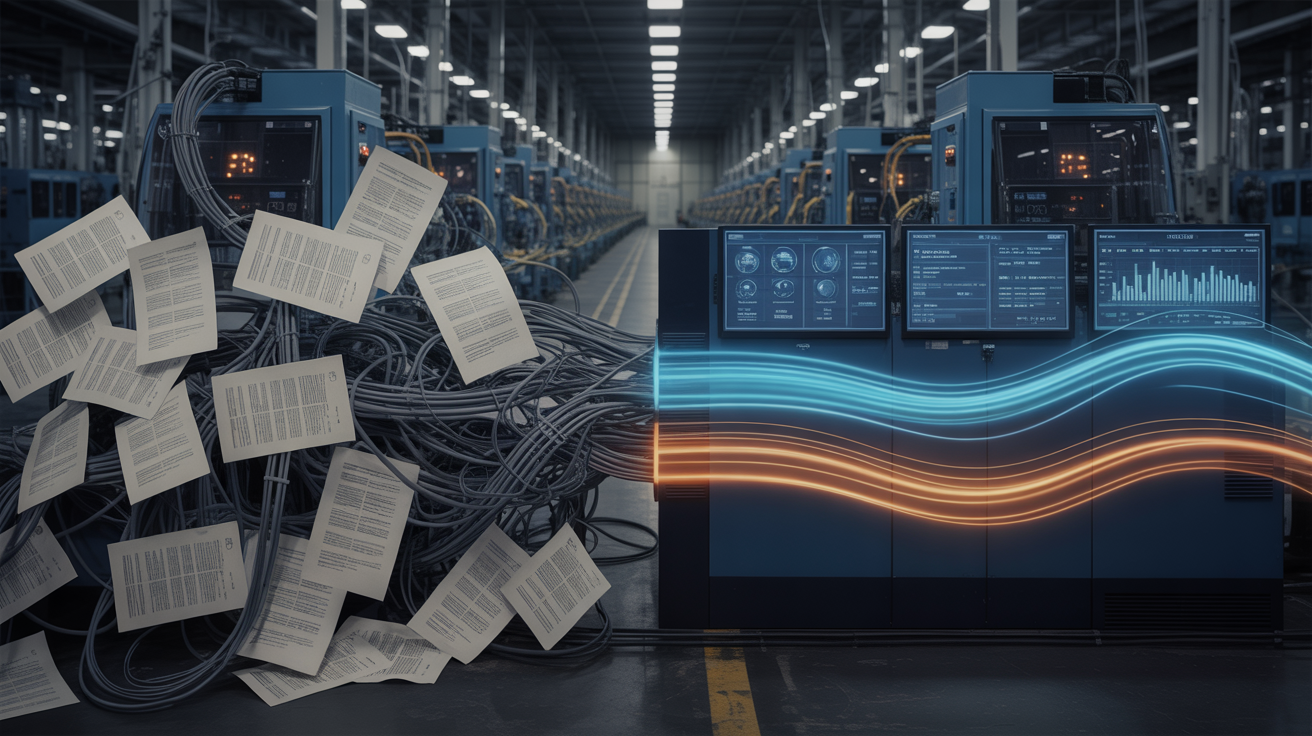
The ₹25 Lakh Data Problem: Why Most Factory AI Projects Fail Before the Model Even Starts
Week 1 was excitement. Week 2 was confusion. By Week 3, the vendor asked a simple question:
"Can you share last year's downtime reasons machine-wise?"
The plant head stared at him. They had downtime… but not downtime reasons. They had breakdowns… but not consistent categories. They had production… but in three different Excel formats across three shifts.
The AI project didn't fail because the model was wrong. It failed because the factory couldn't feed it.
This is the ₹25 lakh data problem.
The 30-Second Version
You can buy AI. You can't buy discipline. Most factory AI failures happen before machine learning starts—at missing logs, inconsistent definitions, and unlabelled outcomes. AI is downstream. Measurement is upstream. If upstream is broken, downstream doesn't matter.
The Uncomfortable Truth
Most factory "AI failures" happen before machine learning starts. Not at neural networks. Not at model accuracy. Not at "advanced algorithms."
They fail at:
- Missing logs
- Inconsistent definitions
- Unlabelled outcomes
- Timestamps that don't match
- No one owning the data end-to-end
AI is downstream. Measurement is upstream.
If upstream is broken, downstream doesn't matter.
The Promise vs. the Reality
What Vendors Promise
"Connect your data and the AI will optimize your factory."
What Often Happens
You discover you don't have data. You have activity.
You have machines running—without reliable cycle time records. You have defects—without defect type labels. You have downtime—without reason codes. You have dispatch delays—without root cause categories.
And the most expensive part isn't software. It's the time your team spends trying to reconstruct reality from fragments.
What "Data" Actually Means in a Factory
When vendors say "data," most factories imagine ERP reports, daily production sheets, and a few sensor readings. That's not enough.
For most useful AI use cases, you need three things:
No alignment = No learning.
The Factory Data Readiness Ladder
Think of factory data maturity like a ladder. Most teams try to jump to the top rung because a vendor told them they could. They can't.
"We are AI-ready"
- Clean, consistent definitions
- Labels for outcomes that matter
- A feedback loop (when AI is wrong, someone updates the system)
- Ownership (one person/team accountable for the dataset)
Only at this rung does AI become a lever instead of a distraction.
"We have reliable instrumentation"
You can trust timestamps, machine state, counts, and key process parameters. Not "IoT everywhere." Just enough to stop arguing about what happened.
"We log basics consistently"
Plan vs actual by line, downtime reason codes (even if rough), scrap/rework with a few defect categories. This alone usually improves performance—because what's measured gets discussed.
"We run on memory + Excel"
Production numbers exist, but definitions change by shift. Downtime is "breakdown" or "power" or "waiting"—everything else is invisible. Defects are seen, fixed, and forgotten.
AI at this stage is theatre.
The Real Killer Isn't Missing Data
It's Shifting Definitions
Ask three people in a factory: "What counts as downtime?" You'll often get three answers.
Maintenance counts only breakdowns.
Production counts changeovers too.
Planning counts "waiting for material."
Quality counts "hold."
Everyone is right locally. And the dataset becomes useless globally.
AI models can learn patterns. They cannot learn from contradictions.
Before you collect more data, you need a downtime taxonomy and a defect taxonomy that the whole factory agrees on. Not perfect. Just consistent.
5 Questions Before You Buy Any AI Platform
If a vendor can't engage these questions clearly, pause.
What's the exact decision this AI will improve?
Not "optimize operations." A real answer: "Predict which pump seal will fail in 2 weeks."
What labels will we use, and who will create them?
If the answer is vague, the project is already in danger.
How do you handle false positives and false negatives?
In factories, wrong calls cost real money.
How much historical data do you need—and do we actually have it?
If you don't have 6–12 months of clean history, your first project isn't AI. It's data foundation.
What's the go/no-go metric for the pilot?
If there's no kill criterion, you're not running a pilot. You're funding hope.
When AI Makes Sense (and When It Doesn't)
AI Makes Sense When:
- • Pattern recognition at scale (vision QC, anomaly detection, predictive quality)
- • Output is measurable (pass/fail, defect types, downtime categories)
- • You have 6–12 months of stable history (sometimes 2+ years)
- • Cost of being wrong is understood and managed
AI Usually Doesn't Make Sense When:
- • Production is low volume, high mix
- • Quality criteria are subjective
- • Definitions change weekly ("today scrap, tomorrow rework")
- • Factory doesn't have baseline measurement discipline
Sometimes the smartest AI decision is: not yet.
The Practical Implementation Path
If you want AI outcomes, here's the boring sequence that wins.
Pick one use case, not "AI transformation"
Choose one: defect detection on one line, downtime prediction for one critical asset, predictive quality for one product family. If you try to "optimize the factory," you will build nothing.
Define the outcome and taxonomy
What exactly is a defect? What types exist? What exactly is downtime? Make a one-page definition sheet. Get sign-off. This is your real foundation.
Fix logging before buying sensors
Most factories can improve dramatically with: plan vs actual every shift, top 5 downtime reasons, scrap and rework by defect category.
Add instrumentation only where it earns its keep
You don't need sensors everywhere. Instrument the point that connects to the decision.
Collect baseline data (8–12 weeks minimum)
You need "normal." Otherwise your model learns noise.
Run a pilot with parallel verification
Don't trust demo accuracy. Run AI output + human/actual outcome for 2–4 weeks. Measure false positives, false negatives, operational impact.
Scale only if the loop exists
Scaling requires: retraining plan, ownership, change management, SOPs for "what to do when AI flags X." Without the loop, scale becomes drift.
The Honest Cost Math
Why It Becomes a ₹25 Lakh Problem
Visible Costs
- • Platform license
- • Integration
- • Sensors (if any)
Hidden Costs (Usually Larger)
- • Team time to clean data
- • Time spent arguing definitions
- • Time spent labeling outcomes
- • Rework to fix logging discipline
- • Pilot drift because no one owns the dataset
A realistic "AI readiness build" can easily cost ₹10–25 lakhs in effort before the model delivers anything. Not because vendors are evil. Because factories are complex—and measurement is hard.
The Bottom Line
AI in factories is not magic. It's a multiplier.
If you already have discipline, definitions, and data ownership, AI can create real wins.
If you don't, AI will amplify your confusion.
So before you buy the AI layer, build the measurement layer.
That's not glamorous. But it's the part that actually makes the model possible.
The Bigger Lesson
Most factories don't have an AI problem. They have a visibility problem.
Leaders can't improve what they can't see clearly—shift by shift, line by line, reason by reason.
Once the factory has a shared language for downtime, defects, and performance, improvement stops being heroic… and becomes repeatable.
And only then does AI become a tool you can trust.
💡 From The Idea Smith
If your AI pilot keeps stalling, it's rarely because the model is "not good enough." It's because the factory doesn't yet have a clean daily loop for plan → performance → problems, with consistent reason codes and outcome labels.
At The Idea Smith, we help factories set up that foundation through a practical AI Readiness + Data-to-Decision system—so your teams stop debating what happened, start learning daily from plan vs actual gaps, and only then deploy AI where it truly earns its cost.
Key Takeaways
- Most factory AI failures happen before ML starts: missing logs, labels, definitions, and time alignment
- You can't skip the Data Readiness Ladder; AI readiness is built, not bought
- Standardize downtime/defect taxonomies before collecting "more data"
- Start with one use case and a clear decision, not "AI transformation"
- Run pilots with parallel verification and track false positives/negatives
- Hidden costs (cleaning, labeling, ownership) often turn into a ₹10–25 lakh "data problem"
- AI is a multiplier: it amplifies discipline—or amplifies confusion
If this helped you see through the noise, share it with another factory owner, COO, or plant head wrestling with the same questions. Forward it on WhatsApp, post it on LinkedIn or X, or print it out for your Monday morning production meeting.
And if they haven't subscribed yet? Point them to thefactoryai.in. Two emails a week, zero fluff.
If this helped you see through the noise, share it with another factory owner, COO, or plant head wrestling with the same questions. Forward it on WhatsApp, post it on LinkedIn or X, or print it out for your Monday morning production meeting.
And if they haven't subscribed yet? Point them to thefactoryai.in. Two emails a week, zero fluff.